
India Inc on Thursday pitched for lowering income tax burden on common man, increase in capital expenditure, and firm steps to contain food inflation in their nearly two-hour long interaction with finance minister Nirmala Shitharaman ahead of the Union Budget. During pre-Budget consultation with Sitharaman, the industry leaders and associations also urged the government to focus more on infrastructure development with a view to maintaining the economic growth momentum. The industry leaders also laid stress on boosting the MSME (micro, small, and medium enterprises) sector, considered a backbone of the Indian economy and main employment generator.

Union Finance Minister Nirmala Sitharaman on Tuesday said the fiscal deficit for 2024-25 is estimated at 4.9 per cent of GDP.

Union Finance Minister Nirmala Sitharaman, along with her team of bureaucrats, delved into the fine print of the 2024-25 Budget documents in a press conference, detailing the government's road map on bringing down the debt-to-GDP ratio and bold tax measures.

Anticipating US action on tariffs, India seems to have made the first move by revamping its tariff structure by reducing the slabs to eight rates, points out Mukesh Butani.


The fiscal deficit for FY25 has been pegged at 4.8 per cent of GDP and at 4.4 per cent for FY26, Finance Minister Nirmala Sitharaman said on Saturday. Presenting the Budget 2025-26, she said net market borrowings are estimated at Rs 11.54 lakh crore for next fiscal year.
While the capital spending is being maintained at 3.1 per cent of the GDP, a little more would have boosted economic growth even further, suggests Rajiv Memani.

Thrust on infrastructure and capital expenditure is expected to continue in the Union Budget for FY25.

For every rupee in the government coffer, the biggest pie of 66 paise will come from direct and indirect taxes, according to the Union Budget 2025-26 documents. Around 24 paise will come from borrowings and other liabilities, 9 paise from non-tax revenue like divestment, and 1 paise from non-debt capital receipts, the Budget documents said.

Hospitality players want the government to accord infrastructure status to hotels to make investments on new properties more attractive rather than categorising them as luxury or even 'sin goods' in the upcoming Union Budget considering the sector's potential to play a key role in India's growth. They also want the government to consider incentives in the form of tax breaks or subsidies for adopting sustainable and eco-friendly practices, while asserting that the upcoming budget must accelerate the tourism agenda saying it is an opportunity to make Indian hospitality the emerging engine for GDP growth and employment generation.

Ushering in reforms, Union Finance Minister Nirmala Sitharaman on Saturday proposed to open up the nuclear power sector for private players and announced a Rs 20,000 crore Nuclear Energy Mission for research in the field, with an aim to set up five small and modular reactors by 2033.

The Union Budget 2025-26 on Saturday allocated Rs 2,33,210.68 crore to the Ministry of Home Affairs with the majority of the fund -- Rs 1,60,391.06 crore -- being given to central police forces like Central Reserve Police Force (CRPF), Border Security Force (BSF) and Central Industrial Security Force (CISF) which are responsible for internal security, border guarding and security of vital installations.

The generation of quality jobs and skill development should be the focal point, cutting across ministries and departments, asserts Nivedita Mookerji.
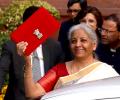
Sitharaman, India's first full-time woman Finance Minister, broke away from the colonial tradition of carrying a Budget briefcase in July 2019, opting instead for a traditional 'bahi-khata', to carry the Union Budget papers.

The resilience of the economy and strength of domestic demand will continue to make India an engine of growth amid the rapidly evolving global trade landscape as a result of US tariffs, Finance Minister Nirmala Sitharaman said in London on Tuesday.

The TMC-led West Bengal government has already started laying the groundwork for the election, setting the tone with the recent Bengal Global Business Summit and the state Budget.

Union Finance Minister Nirmala Sitharaman will present the Interim Budget on February 1 ahead of the Lok Sabha elections likely to be held in April-May.

Opposition leaders slammed the Centre on Wednesday for its 'limited' focus on important sectors like health and education in the Budget for 2023-24 fiscal.

The Finance Ministry has started preparations for Budget 2014-15 by asking different central ministries and departments to come out with their estimates of receipts as well as expenditure for the next financial year.

Indian National Developmental Inclusive Alliance (INDIA) MPs, including Congress president Mallikarjun Kharge, Congress Parliamentary Party chief Sonia Gandhi and Leader of Opposition in the Lok Sabha Rahul Gandhi, staged a protest in Parliament premises on Wednesday over the alleged discrimination against opposition-ruled states in the Union Budget.

'...how do they consume and contribute to the GDP?'

Simplifying GST rates, removing exemptions, easing disputes, and speeding up refunds can boost investment in India and offer the best reply to Trump's tariffs, observes V S Krishnan, former member, Central Board of Indirect Taxes and Customs.
The eighth Budget of Finance Minister Nirmala Sitharaman continued to focus on 'GYAN' (Garib, Youth, Annadata, Nari) to maintain a consistent and coherent strategy initiated over the years in pursuing the government's vision for Viksit Bharat. The approach, characterised by incremental yet impactful steps, aims to create a compounding effect over time.

Geopolitical tensions, trade policy uncertainties, volatility in international commodity prices and financial market uncertainties pose considerable risks to India's economic growth in the coming year, the finance ministry cautioned on Wednesday. "Global trade continues to be affected by uncertainty in the policy environment... tariff-related developments in multiple countries have heightened trade-related risks, affecting investment and trade flows globally.
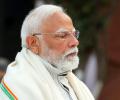
Prime Minister Narendra Modi said on Friday that there have been no attempts from abroad to stoke trouble in India ahead of the Parliament's Budget session, which begins on Saturday. Modi's statement comes as his government prepares to present its first full-fledged budget in its third term. He expressed confidence that the Budget session will infuse new confidence and energy in attaining the goal of 'Viksit Bharat' by 2047, and said his government has been working in a mission mode for an all-round development.

'The finance minister missed yet another opportunity to simplify the income tax structure in the Budget.' 'This was an opportune moment to get rid of the old tax system entirely and move fully to the new system,' asserts M Govinda Rao, member of the 14th Finance Commission.

'The new Bill introduces no policy or rate changes, leaving financial planning strategies largely unaffected.'
'The considerations for choosing between the old and new tax regimes remain essentially unchanged.'

The Budget announcement of zero tax for earnings upto Rs 12 lakh per annum and the rejig of tax slabs across the board should prompt more than 90 per cent of individual taxpayers to embrace the new tax regime as compared to the about 75 per cent as of now, CBDT Chairman Ravi Agrawal said. Agrawal also highlighted the government's focus on "non-intrusive" tax administration through enhanced use of Artificial Intelligence (AI) and simplified tax processes for common taxpayers. He emphasized the benefits of the new tax regime (NTR), which offers simple calculations and allows taxpayers to file their ITR without professional help. The CBDT chief stated that the Budget provisions related to income tax payment benefit all income earners, not just those earning Rs 12 lakh per annum, creating a positive sentiment in the economy and propelling growth. The department is also harnessing technology, including AI and data analytics, to widen and deepen the tax base, resulting in increased compliance and tax revenue. Agrawal further highlighted the positive impact of data availability and simplified tax processes on compliance rates, citing examples of taxpayers filing revised returns and paying taxes after being prompted by the department's data analysis.

The interest rate on these schemes have remained unchanged for over a year now.

Finance Minister Nirmala Sitharaman on Saturday said Rs 1.5 lakh crore will be provided towards 50-year interest free loans to states, for infrastructure development. Also, an asset monetisation plan will be launched for 2025-30 period to infuse Rs 10 lakh crore capital in new projects.

MeitY is in discussions with global Fortune 500 and Fortune 1000 companies, mid-tier firms, and state government officials on a three-pronged approach to setting up new GCCs in India.

Mortgage finance remains a structural growth opportunity in India with a policy focus on affordable housing, housing shortages, low mortgage penetration, and rising incomes as drivers. Affordable Housing Finance Companies (AHFCs) serve the mass market, low-income segments, which is the least-serviced category, and to operate in this segment, the mortgage provider needs good assessment skills. AHFCs and HFCs have also been increasing exposure in other mortgage segments (loan against property, developer loans among others).

Here's how the budget impacts the pocket of the common man.

Finance Minister Nirmala Sitharaman will present her sixth straight Budget ahead of the Parliamentary elections, matching the record of former Prime Minister Morarji Desai. Sitharaman in her pre-election Budget, which technically is a vote on account and popularly termed an interim Budget, will seek Parliament's nod for a grant in advance to meet the central government's essential expenditure for the first four months of the new fiscal year that starts in April. A new government elected after the April/May general elections will present the full Budget, likely in July.

'Nearly 10 million people will benefit from the increase in the rebate limit for those earning up to Rs 12 lakh.' 'We expect all that money will come back into the economy in either savings, consumption, or investments.'

The RBI under new Governor Sanjay Malhotra on Friday cut interest rate for the first time in nearly five years as the central bank pivoted the policy stance to support a shuttering economy. The 25 basis points rate cut to 6.25 per cent comes after last rate reduction in May 2020. The last revision of rates happened in February 2023 when the policy rate was hiked by 25 basis points to 6.5 per cent.

Pre-Budget excercise next month should scrupulously avoid adventurism of all types and refrain from making excessively ambitious projections on revenue and expenditure numbers for 2023-24, suggests A K Bhattacharya.

Prime Minister Narendra Modi on Thursday said the interim Budget presented by Union Finance Minister Nirmala Sitharaman offers the "guarantee" of strengthening the foundation of a developed India and carries the "confidence of continuity".
 © 2026 Rediff.com - Advertise with us - Disclaimer - Privacy Policy - Sitemap - Feedback - About us - Terms of use - Grievances